
Articles · Economics
The price ceiling: 1,700 years of the same mistake
From Emperor Diocletian to American gas lines to Stockholm's housing queue. Why price controls do not make goods cheaper, they hide them in a queue.
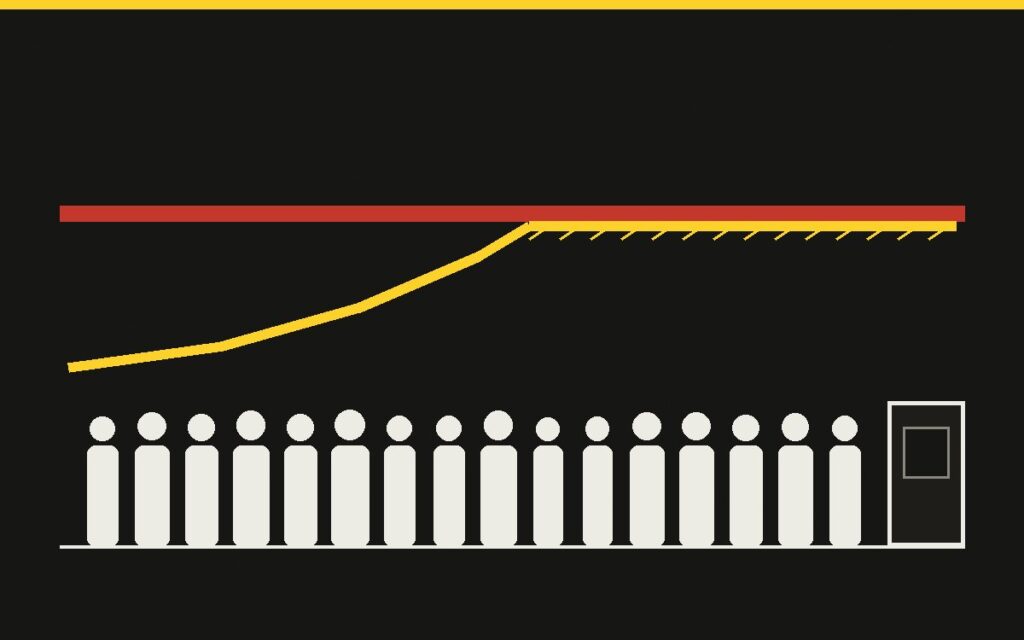
Whenever something gets more expensive, the same proposal comes up: let us set a maximum price. It sounds reasonable and kind. It has just one flaw: it has been tried so many times that we know the result in advance. You can ban a price. You cannot ban the shortage that the high price is reporting.
Diocletian’s edict, AD 301
The Roman emperor Diocletian was fighting an inflation the state had caused itself by debasing the silver in its coins. In 301 he issued the Edict on Maximum Prices, with fixed ceilings for more than a thousand items, from wheat to a shave at the barber’s. Breaking it could mean death.
According to the contemporary writer Lactantius, merchants stopped bringing goods to market at all, prices kept rising and blood was shed over trifles. Within a few years the edict was no longer enforced. Goods cannot be ordered to exist at a price at which nobody can afford to make or deliver them.
Gas lines in America
In August 1971 President Nixon froze wages and prices. Controls on oil and gasoline prices then lasted, in one form or another, through the whole of the 1970s. When the oil shocks hit in 1973 and 1979, the price of gasoline was not allowed to rise enough to show that it was scarce. The result was lines of cars stretching for blocks, stations closing halfway through the day, and odd-even rationing by license plate.
The oil shocks hit countries without price ceilings too. The long lines, though, formed mainly where the price was not allowed to do its job. When the controls were lifted in 1981, the lines disappeared.
Waiting for a flat in Stockholm
Rent control is a price ceiling on housing. Stockholm has a version in which rents are negotiated centrally and may not reflect demand. If you want an ordinary lease, you join the city’s housing queue and wait. On average almost ten years, and much longer for the inner city. In the meantime, flats are sublet on the black market and passed down in families.
Simulator
What a rent cap does
- Flats on offer
- –
- People who want one at this rent
- –
- Left without a flat
- –
- What the last flat would fetch under the table
- –
The Swedish economist Assar Lindbeck, himself a social democrat, wrote a sentence about this in 1972 that economists learn by heart: rent control appears to be the most efficient technique known to destroy a city, except for bombing.
And in Czechia?
Czechia knows both from experience. Under socialism prices were fixed, and shortage took the form of goods kept under the counter, connections, and waiting lists for cars that lasted years. Rent control survived in Prague and other large cities until the end of 2012. It created two worlds: lucky tenants with an old lease, and everyone else, who paid market rent in the rest of the market, where flats were all the more expensive.
Why it always ends the same way
A price is not just a number on a label. It is a message. A high price tells producers “make more, it pays” and buyers “economize, there is not much of it”. A ceiling bans the message, but the shortage does not go away. Instead of money, people start paying with time in a queue, with connections or with bribes. Economists call this the knowledge problem: nobody at the top knows how much of what is needed, and the price is the only way everyone finds out.
What instead of a ceiling
When something gets more expensive, the fastest help is not a ceiling but freer supply: fewer obstacles for those who want to build, import or produce. A high price is an invitation to them. A ceiling tears the invitation up.
If a politician wants to help someone with their bills, it is more honest to give money directly to people in need than to hide the cost in a queue. That does not make it free: taxpayers pay for it, and often so do the very people being “helped”. To see how a market coordinates millions of people without a central plan, read the Austrian economics guide, and for the hidden costs of state intervention, the glossary entry on price controls.
Your progress
Saved only in your browser. We do not track you. Read all 14 guides and you get a diploma. All guides →Keep it, share it
Save the article as a PDF to read offline, or send it to someone who should read it.
Was it worth your time?
The guides are free and carry no banner ads. A few sats help keep it that way.
Send a tipYour diploma
You have read all 14 guides. Congratulations!
Your name stays in your browser. We never see it.