
The 2028 halving: why Bitcoin slows down while everything else speeds up
Around spring 2028 the reward for a new Bitcoin block drops by half, from 3.125 to 1.5625 BTC. What exactly happens, what does not, and why it is the opposite of what central banks do.

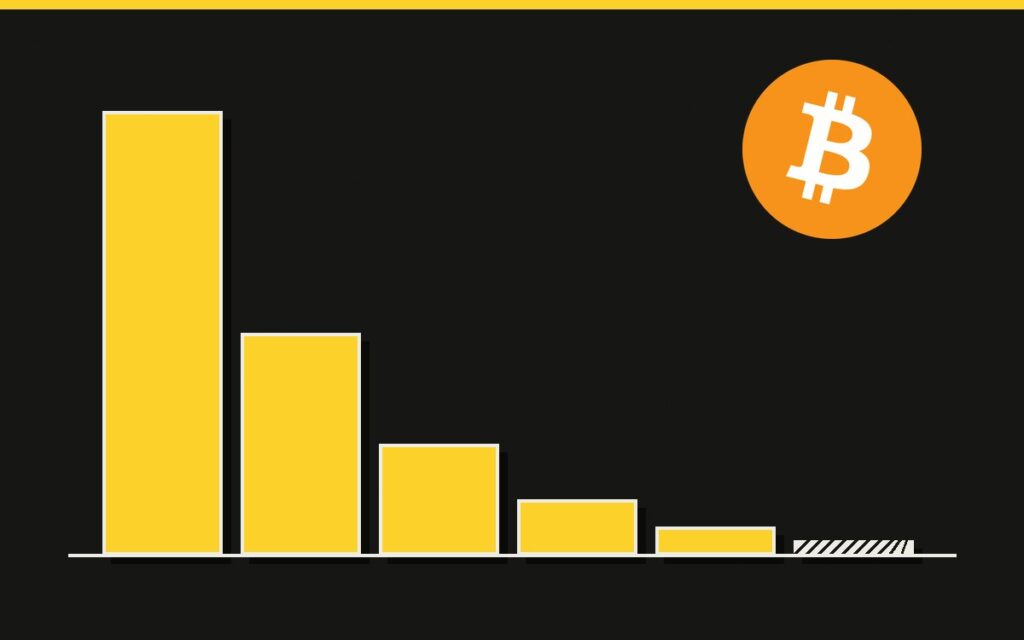
Most of the world’s money shares one feature: there is more of it whenever that is convenient. A crisis, a pandemic or an election comes along, and the central bank adds some. Bitcoin works the other way round. Its new supply is cut in half every four years, whatever happens, and nobody can vote for a different outcome. The next cut, called the halving, is due around spring 2028.
What exactly happens
New bitcoins are created as a reward for the miners who add a new block to the chain. At the start, in 2009, it was 50 BTC per block. Every 210,000 blocks the reward is divided by two:
- November 2012: 25 BTC,
- July 2016: 12.5 BTC,
- May 2020: 6.25 BTC,
- April 2024: 3.125 BTC,
- around spring 2028 (block 1,050,000): 1.5625 BTC.
Nobody sets the exact date. Block 1,050,000 arrives when it arrives. Because the network keeps a pace of about one block every ten minutes through the difficulty adjustment, it can be predicted to within weeks.
What it means in percent
Today about 450 new bitcoins are created per day, around 164,000 per year. With roughly twenty million coins in existence, the supply grows by about 0.8% a year. After the 2028 halving it will be about 0.4%.
For comparison: most central banks aim for prices to rise 2% a year, and in 2022 inflation in much of Europe and the US went far above that; in Czechia it averaged 15.1% for the year. The stock of gold, the classic sound money, grows through mining by roughly 1.5 to 2% a year. Measured by how fast new supply arrives, Bitcoin is already scarcer than gold, and in 2028 it becomes scarcer still.
Why it matters
When someone prints the money in your pocket, you pay them a hidden tax. It is called inflation, and those who receive the new money first gain the most from it. Bitcoin switches that mechanism off: the issuance schedule is public, written in code and the same for everyone.
What does not happen
Halvings attract plenty of myths, so for the record:
- Your bitcoins are not cut in half. The halving only affects newly created coins. What you already own stays as it is.
- The price does not shoot up automatically. After past halvings the price rose over the long run, but the market knows about each halving years in advance. Anyone promising a sure profit is selling something.
- The network does not stop. For users nothing changes. Transactions work the same as the day before.
What it means for miners
For miners a halving is a hard day: overnight they get half the new coins for the same work. Less efficient machines stop paying for themselves and are switched off, the difficulty then falls and the rest of the network carries on. It is exactly the kind of spontaneous order that nobody runs: each miner decides alone, based on their own costs, and the network as a whole adapts.
In the long run, the block reward is meant to be replaced by something else: transaction fees. Around 2140 the last satoshi will be created, and from then on miners will be paid only by users who want their transaction in a block. Whether fees will be enough to secure the network is one of the few honest open questions about Bitcoin. We look at it in the chapter on Bitcoin’s limits.
Money nobody can vote on
The most interesting thing about the halving is not the price or the mining. It is the fact that it happens even though many people would love to postpone it. Nobody can call an emergency meeting and decide that this time the reward will not be cut. The rules can only change if they are voluntarily adopted by the overwhelming majority of users who run their own nodes, and they have no reason to dilute their own savings.
That is the lesson that matters to ancaps: rules that hold because people share them voluntarily, not because someone enforces them. If you want to see the issuance schedule on a chart all the way to 2140, it is on the Bitcoin page.
Sources
- Satoshi Nakamoto: Bitcoin: A Peer-to-Peer Electronic Cash System (2008), and the Bitcoin Core source code (the 210,000-block halving interval).
- Block explorers (e.g. mempool.space): heights and dates of the halvings at blocks 210,000, 420,000, 630,000 and 840,000.
- Czech Statistical Office (ČSÚ): average annual inflation 2022, 15.1%.
- World Gold Council: above-ground gold stocks and yearly mine production.
Your progress
Saved only in your browser, never sent to us. Read all 14 guides and you get a diploma. All guides →Keep it, share it
Save the article as a PDF to read offline, or send it to someone who should read it.
Was it worth your time?
The guides are free and carry no banner ads. A few sats help keep it that way.
Send a tipYour diploma
You have read all 14 guides. Congratulations!
Your name stays in your browser. We never see it.